
This humidity sensor can be used in experiments in which the presence of moisture or even water is to be detected. Another interesting application is in checking the state of tissues or papers if they are perfectly dry. The circuit is extremely sensitive causing the LED to light up with resistances of many megohms which means a very low degree of humidity in the tested but existing objects.
The power consumption in standby condition (LED off) is so low that we omit the main switch as there is no need to turn off the power supply under these conditions.
In figure 1 we have the complete diagram of the sensor.
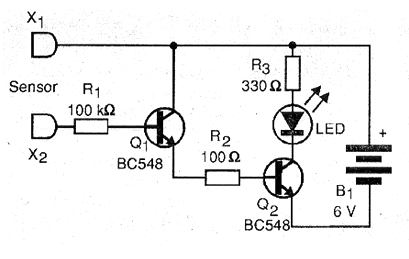
The two transistors connected in Darlington stage ensure excellent sensitivity.
We can use any general-purpose NPN transistors, but we must be careful that neither transistor will leak, as this would cause the LED to remain permanently lit even with no moisture present in the sensors.
With the device switched on and nothing is touching the sensors, the LED should be completely off, which is a sign that everything is fine with the transistors and the rest of the circuit.
In figure 2 we have the arrangement of the components in a terminal strip that can be easily installed inside a plastic box.
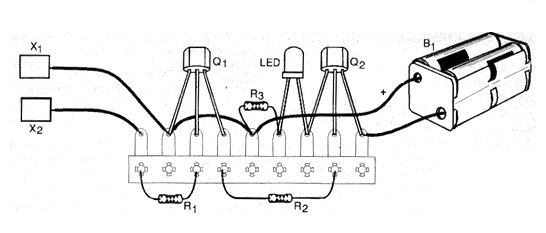
The LED is common red and stays in the box panel and can be used to fix a holder. The resistors are 1/8 W or larger and the sensors can be two metal plates placed on the bottom of the box, as shown in figure 3.
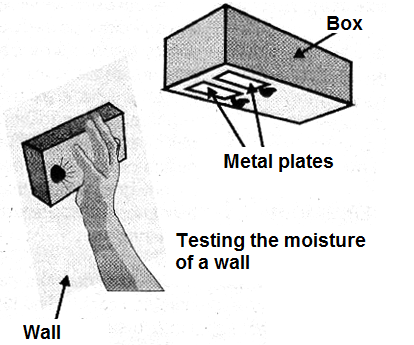
These inserts must come into contact with the object to be tested for moisture.
To use the apparatus to detect the water level of a reservoir or a leak, we can use sensors as shown in figure 4.
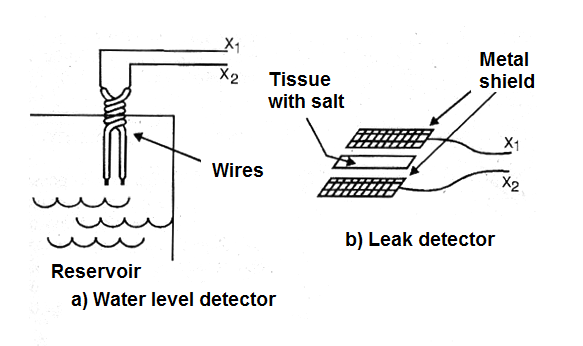
The power supply for the device consists of 4 small, standard batteries installed in a suitable holder.
To use the device simply touch it on the object from which you want to check the humidity.
The object must not be conductive. If the LED lights up the object is damp and the greater the humidity the greater the brightness of the LED.
If we lean the sensors on a wall, for example, we can have the indication that the moisture detected is caused by a leak in a water or sewage pipeline.
When not used for long intervals, it is convenient to remove the batteries from the stand.
WHAT TO EXPLAIN
Water containing mineral salts or dissolved impurities is conductive to electricity. Thus the moisture present in certain objects makes them conductive.
This conductivity is detected by the apparatus described.
Teachers and students may be based on this fact to explain the principle of operation of the apparatus and, in addition:
* Show chemically because the humidity of the objects added to the presence of impurities (dirt) causes the water to be conductive and that the device detects just this conductivity.
* Show that by placing your fingers on the sensor the LED lights up, indicating that the moisture of the skin plus the presence of conductive substances in our body causes the current to be conducted.
* Explain that the current in the sensor is extremely low and therefore there is no danger of shock.
Note: replacing the sensors with two probes will have an excellent continuity tester that serves for numerous experiments in physics.
MATERIAL LIST
Q1, Q2 - BC548 or equivalent - general purpose NPN transistors
LED - red LED or any ordinary color
X1, X2 - sensors - see text
R1 - 100 k ohms x 1/4 W - resistor - brown, black, yellow
R2 - 100 ohms x 1/4 W - resistor - brown, black, brown
R3 - 330 ohms x 1/4 W - resistor - orange, orange, brown
B1 - 6 V - 4 common small batteries
Several:
Battery holder, terminal bridge, LED holder (optional), mounting box, wires, solder, etc.


