
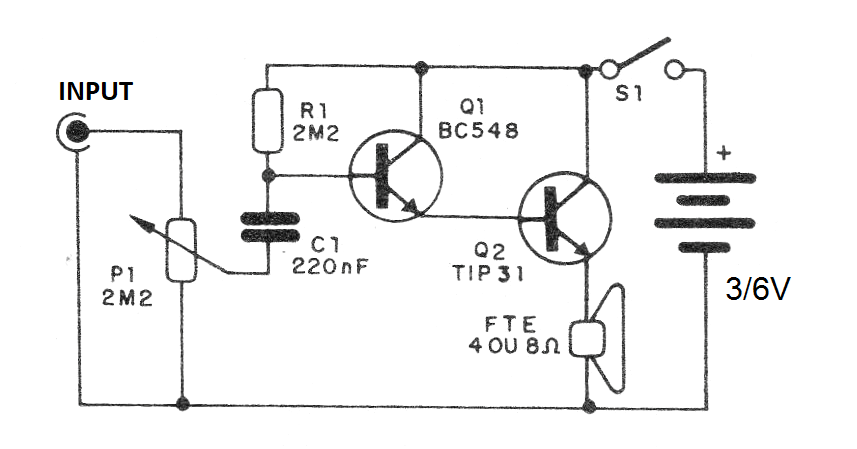
With only two transistors we can have a simple low power experimental amplifiers. With it we can excite a small speaker, getting a few milliwatts of power from signal sources like electret microphones, ceramic capsules, small radios, oscillators, etc.
The amplifier can also be used as a signal and audio tracker and its power can either be made by batteries as a source. We can supply it with voltages from 3 to 6 V and the current consumed will be between 50 and 200 mA.
As it is a very simple configuration, performance is not great, consisting much more in an experimental setup than in the elaboration of devices that require power quality. In figure 1 we have the diagram of the amplifier.
The assembly based on a terminal strip is shown in figure 2.
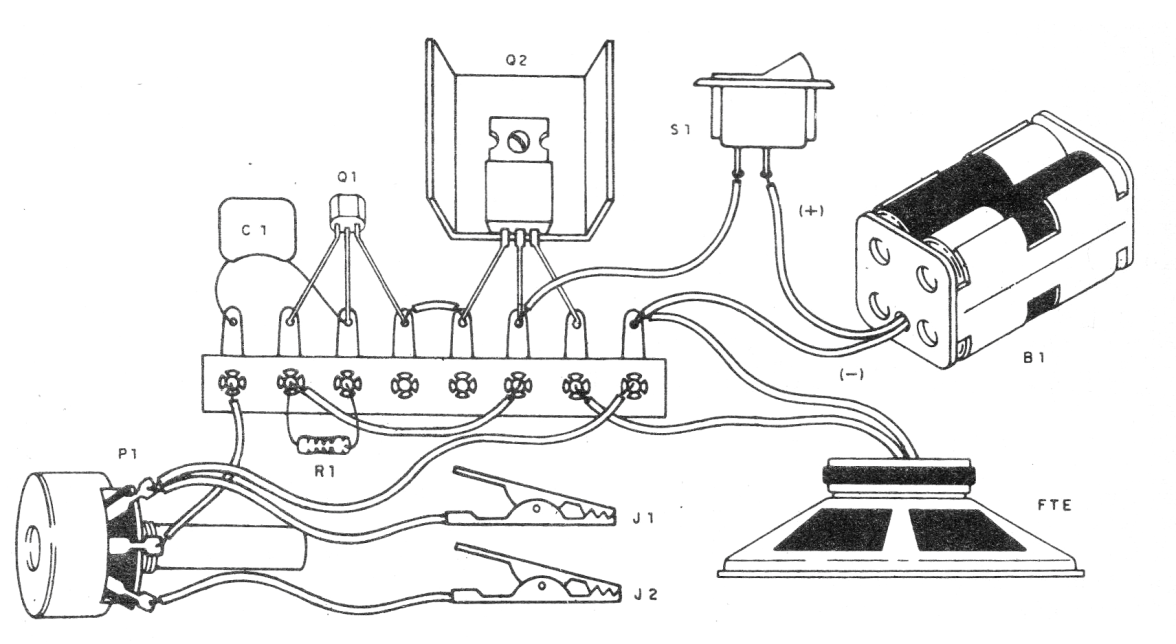
The heat sink in transistor Q2 is required if the circuit is powered by 6 V or more. We can use up to 12 V of voltage, but in this case we should not use batteries, because the consumption would be very high and they would be exhausted with ease. It will be interesting to change R1 between 1 M and 4M7 experimentally to obtain the best sound with the lowest consumption.
For Q1 we can use any general-purpose NPN such as the BC548 and for Q2 PNPs of power such as TIP32. Older transistors can also be tried, such as germanium types.
To test the amplifier, simply connect its input to a signal source by setting P1 to the desired volume. A speaker installed in a small speaker will enhance the sound. If the volume is too low, the signal source is insufficient to excite it.
Material list
Q1 - BC548 - general purpose NPN transistor
Q2 - TIP32- PNP power transistor
S1 - Single switch
B1- 3 to 9 V - batteries or power supply
P1 - 2M2 - potentiometer
FTE - speaker of 4 or 8 ohm - at least 10 cm
R1- 2M2 x 1/8 W- resistor - red, red, wick
C1 - 220 nF- ceramic or polyester capacitor
Miscellaneous: terminal strip, battery holder or source, transistor heatsink, alligator clips, potentiometer knob, mounting box, wires, solder, etc.


