
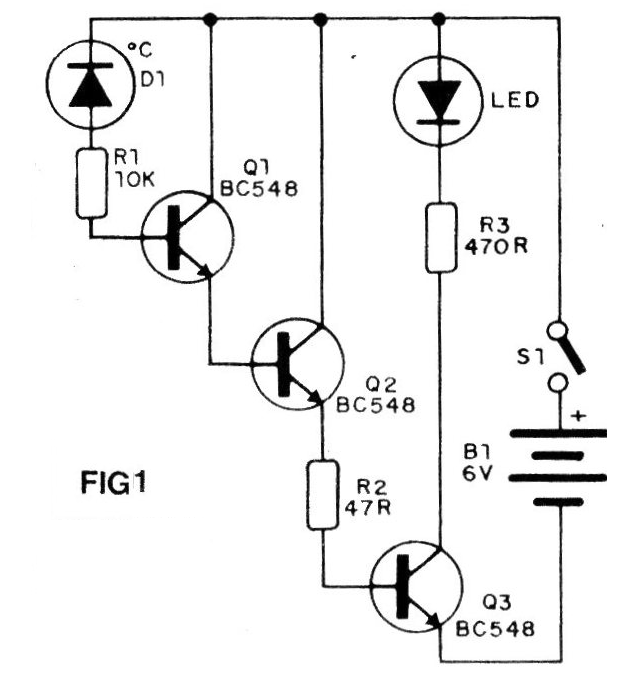
This circuit is sensitive to heat, and can serve as an alarm for overheating of parts, fire or even short circuit. With heat, the sensor, which is a simple diode, conducts the current and causes a warning LED to light up. The sensor can be any diode and the system operates safely at temperatures up to approximately 120° C.
In addition to this value the LED lights up, but the sensor can be damaged.
The operation of this mini-object is simple: the resistance of a common diode decreases with its heating when polarized in the reverse direction.
Using three amplifier transistors, we can increase the intensity of the low current flowing in the diode in these heat conditions and thus get the triggering of a warning LED.
The temperature at which the LED lights up depends on the diode used, and experiments with types such as 1N4148, 1N914, 1N4001, BY127, 1N34 etc. can be made.
Circuit power comes from 4 common batteries (cells) and the LED as well as the sensor can be remote. For the sensor, it is convenient to use shielded wire because the ambient noise can cause a false activation of the led.
ASSEMBLY
In Figure 1, we have the complete diagram of the apparatus, and in Figure 2, the assembly of the apparatus based on a terminal strip.

An interesting application for this circuit is in the detection of the heating of the weldings.
Install the sensor diode into the holder of your soldering iron; when it warms the LED will light up warning you that it is ready for use.
MATERIAL LIST
Q1, Q2, Q3 - BC548 or equivalent - general purpose transistors
D1 - sensor (any diode)
LED - common red LED
B1 - 6 V - 4 small batteries
S1 – On-Off switch (optional)
R1 - 10k x 1/8 W- resistor (brown, black, orange)
R2 - 47 ohm - resistor (yellow, violet, black
R3 - 470 ohm - resistor (yellow, violet, brown)
Miscellaneous:
support for 4 batteries, terminal strip, wires, welding, etc.


