
The purpose of this project is educational, showing how a transistor works with a simple assembly in an array of contacts.
We describe a simple experiments that can be implemented in elementary and middle level courses and serve as an introduction to technology. With it, we learn how a transistor works.
Level: Fundamental, middle and initiation
Purpose: To learn how a transistor works, what is gain and how the current that circulates through the body can control a circuit.
Explanation
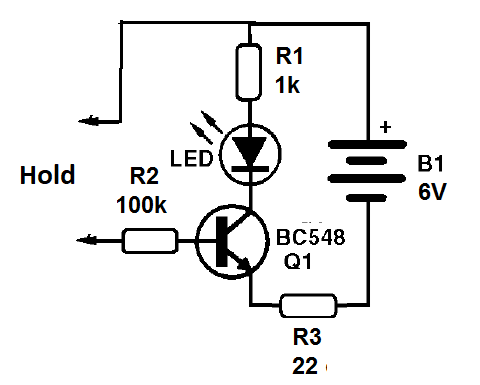
The resistance of a person's skin is very high, not allowing enough current to pass an LED. However, this current can be amplified by the transistor and with that acquire sufficient intensity to drive an LED.
In our experiment, we will use two wires that hold between the fingers, allow to pass a very low current to the base of the transistor. This current is amplified and turns on the LED. Just hold the ends of the wires as the LED lights up.
Assembly
In figure 1 we have the circuit used in the experiment.
The assembly in the contact array is shown in figure 2.
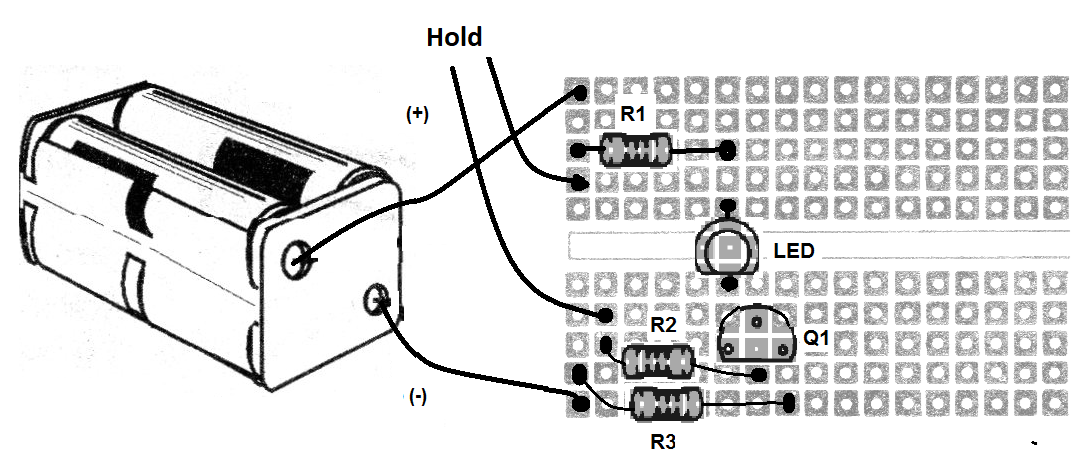
Be careful with the transistor position, LED position and polarity of the batteries in the assembly. Any inversion can cause components to burn.
Note that the brightness of the LED varies when we tighten the wires more and with that the electrical resistance decreases, increasing the current in the transistor.
Used material:
Q1 - BC548 - NPN transistor
LED - LED common
R1 - 1 k ohm - resistor - brown, black, red
R2 - 100 k ohm - resistor - brown, black, yellow
R3 - 22 ohm - resistor - red, red, black
B1 - 4 batteries
Several:
Matrix of contacts, support of batteries, wires, etc.


