
ART2359 ART3139S
Note: The article is from 1988.
As we described in another article, nuclear radiation is detected by special tubes based on the ionization they produce in a gas as they pass through.
Thus, alpha particles (helium nuclei) and beta particles (protons), when passing through a rarefied gas, produce ionization. The electrodes of the valve are then subjected to a high voltage (between 300 and 800 V) so that, now the particle passes through the valve, the gas inside becomes momentarily conductive, thus producing a pulse that can be amplified. (Figure 1)
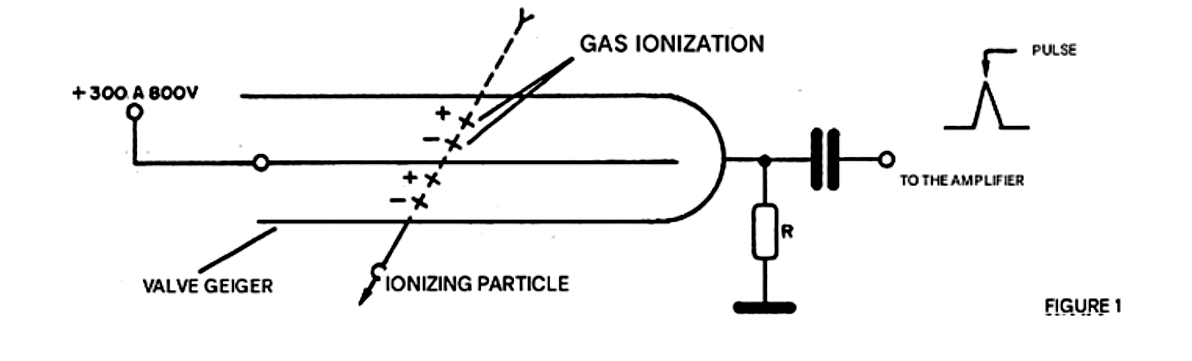
The number pulses heard, or counted by special circuits, gives the degree of radiation incident on the detector. This degree or level of radiation, however, takes into account the relatively large dimensions of the tube.
Thus, for the calibration of a detector or for determining its sensitivity, it is important to know the useful surface that receives the ionizing radiation. Geiger tubes that work in this way are very expensive, delicate components that are difficult to obtain in our market.
Would it be possible to replace them?
Analyzing specialized literature and conducting experiments, we concluded that a semiconductor junction, a diode for example, can also detect ionizing radiation, such as alpha particles. To do this, simply reverse bias a diode with a very high voltage, on the order of 150 volts, as shown in Figure 2, and use a 1 to 2.2M ohm resistor as a load.
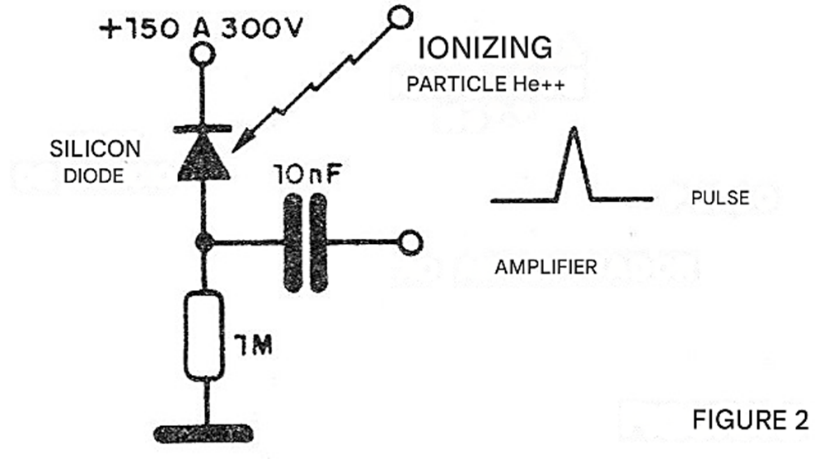
Under normal conditions, without radiation, the current flowing through the diode is minimal, depending only on the release of charge carriers due to thermal agitation of the material's atoms, or due to the incidence of light.
This current, however, has a constant value.
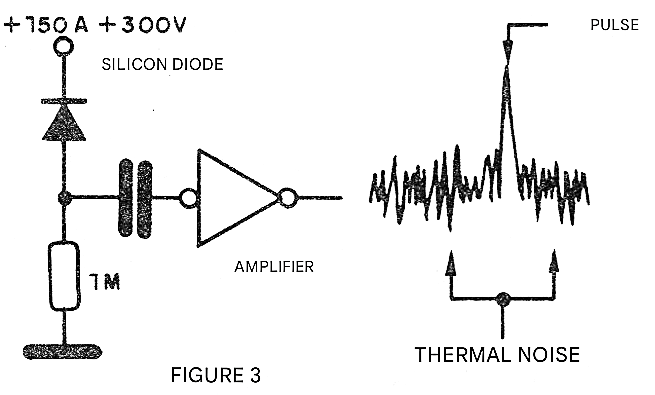
The voltage across the resistor is then maintained at a more or less constant value, with no signal available at the output capacitor. If we connect this circuit to a high-gain audio amplifier, the most we will have is the amplification of thermal noise, which corresponds precisely to the charge carriers released at the junction. (Figure 3)
However, if an ionizing particle hits the semiconductor junction, it will release a certain amount of charge carriers that will produce a current spike in the component. This current spike corresponds to a pulse that can be amplified by the external circuit. (Figure 4)
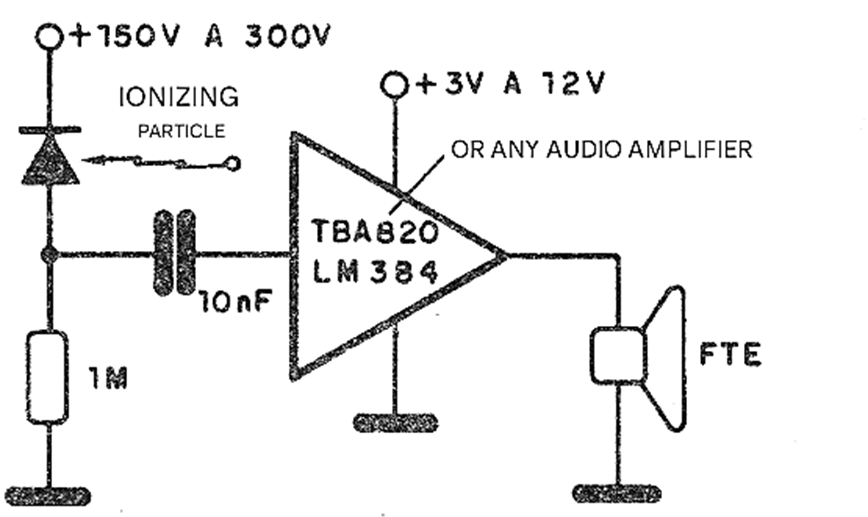
In short, the junction of the semiconductor material detects the radiation incident on it with good sensitivity.
SENSITIVITY PROBLEM
This device has high sensitivity, but there is a problem considering its dimensions. If we take the junction of a common diode, it has dimensions of a few millimeters, thousands of times smaller than the useful surface area of a Geiger tube. Thus, exposing both devices to a source of atomic radiation, as suggested in Figure 5, while dozens of particles will hit the tube every minute, at the diode junction, we will only have one or two particles detected per minute.
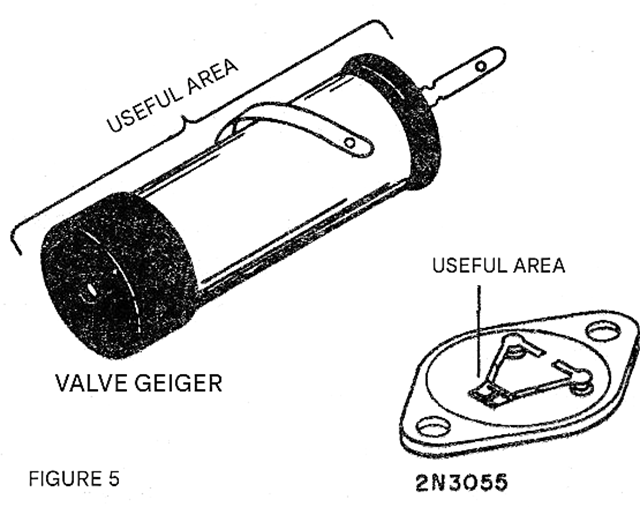
Clearly, if we have a very strong radiation source, the number of particles that hit the junction will be greater and detection easier. What type of component would have a junction of good dimensions to be used as a detector?
The first important point to consider is the ease with which the junction would be exposed to radiation. The second point would be its ability to withstand the high bias voltage and, finally, the size of its "semiconductor chip".
Considering this, we experimented with the very common 2N3055 transistor and obtained satisfactory results. Of course, its exposed junction has dimensions of millimeters compared to the many centimeters of the valve, but the ability to detect radiation, provided it "hits" the component, exists.
Thus, for readers who wish to assemble it, even if the sensitivity is lower due to the aspect of the small radiation-collecting surface, we describe our project.
THE CIRCUIT
Basically, we can replace a Geiger tube with the 2N3055 transistor, as shown in Fig. 6.
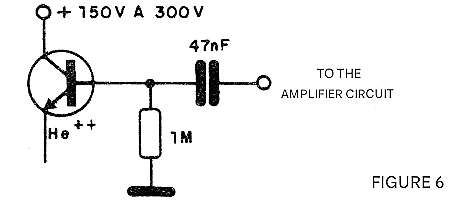
We then have three versions:
a) Version 1 corresponds to a mains-powered detector with a speaker input. (Figure 7)
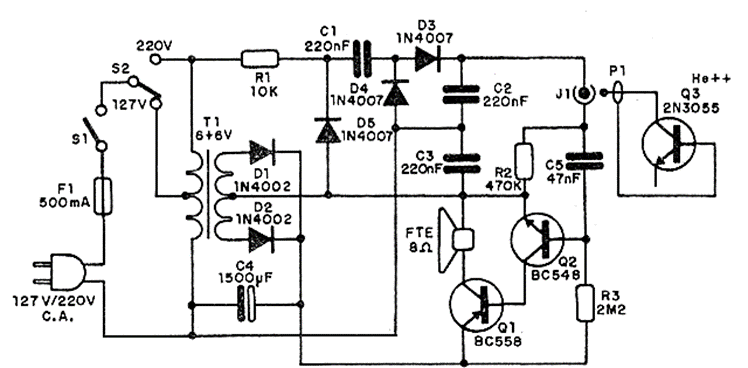
b) Version 2 is battery-powered with a headphone input. (Figure 8)
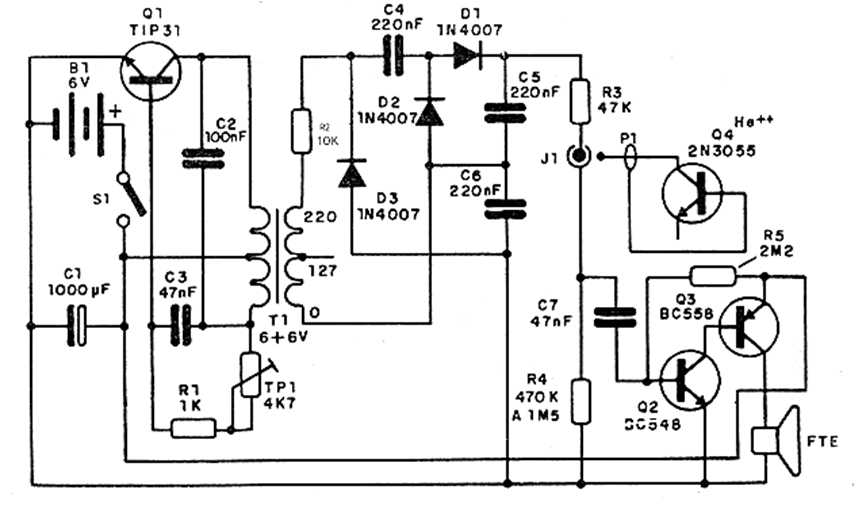
c) Finally, we have version 3, which is battery-powered and excites an instrument. Due to its low sensitivity, this version is not recommended except for detecting very high levels of radioactivity. (Figure 9)
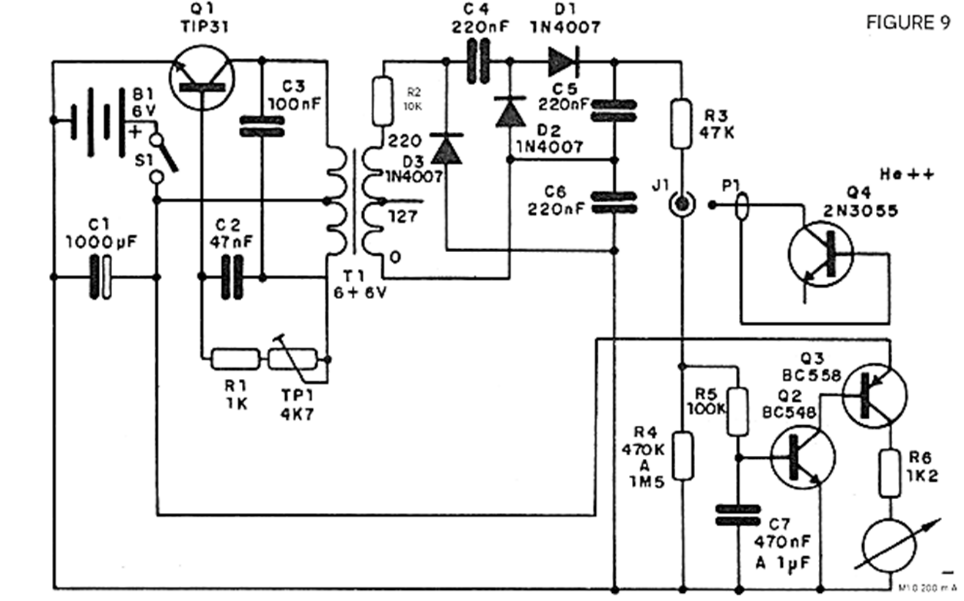
Figure 10 shows the procedure for "preparing" the 2N3055 transistor as a sensor.
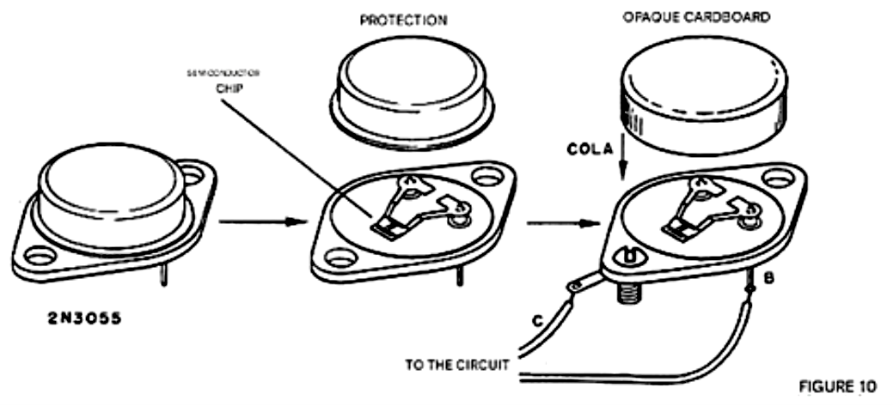
We then remove its casing and expose its junction.
Once the junction is exposed, we must prevent light from reaching it. To do this, we make a dark cardboard shield (alpha radiation can pass through this material).
The connections are made with ordinary wire.
Note: This operation is not simple, as the casings are solidly sealed. However, an alternative that can be tried is to use silicon photocells, which are large and also function as sensors when reverse biased. The sensor should be mounted in a way that facilitates its use, as it must be brought close to the radiation source.
USAGE
When turning on the device, we should only hear a hissing sound, which corresponds to the thermal noise of the semiconductor junction. Upon incidence of any ionizing radiation, a pulse will be produced, resulting in a crackling sound.
The greater the crackling sounds, the greater the intensity of the radiation. Occasional crackling sounds may be heard during functional tests due to the incidence of cosmic rays on Earth. These rays are high-energy particles that constantly bombard Earth from all parts of the universe. Since their quantity is very small, we do not need to fear their effects (such rays have always affected all of humanity and so far nothing serious has happened!). (Figure 11)
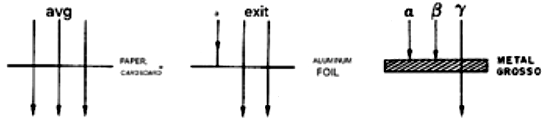
Note: we remind you that this is an experimental device with relatively low sensitivity given the dimensions of the sensor. We suggest that readers experiment with large junction surface area diodes or even other components. Another possibility is the parallel connection of several transistors.
Regarding the radioactive material for the test, since it is difficult to obtain, it must be done using only cosmic rays, except by qualified individuals who have access to alpha particle sources.
PS: very old watch dials that use radium salts exhibit a considerable level of radiation and can be used (with caution) for calibration or to verify the operation of the device.


