ART1302S ART5414
Note: Article published in Eletrônica Total 102 of 2004
Schottky diodes are not new components. They have been in use for over 25 years, mainly in the power supply industry.
But what makes these diodes different from others?
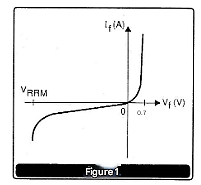
When we analyze the characteristic curve of common diodes, we see that for them to start conducting, a minimum voltage must be reached. This voltage is necessary to break the potential barrier that manifests itself at the diode junction. For common types such as silicon diodes, this barrier requires a voltage on the order of 0.7 V, as illustrated in Figure 1.
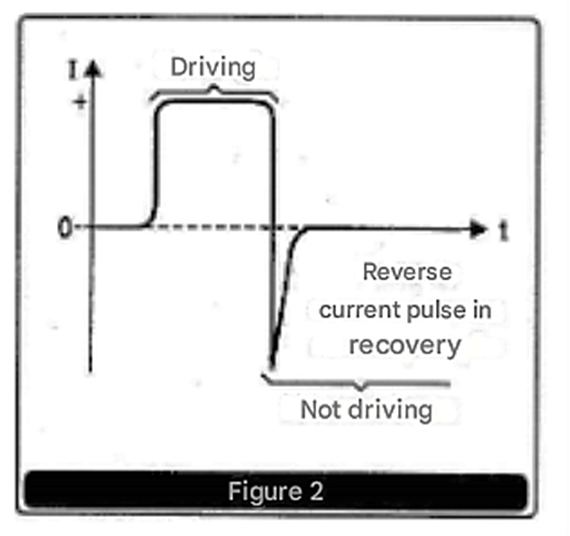
We also observed that common diodes, such as the silicon diodes used in power supplies, are slow devices, needing some time to start conducting, and even more time to recover from the conducting state when the polarity of the applied voltage is reversed.
This reverse recovery time is especially important in many applications. What happens is that, when we reverse the polarization of a diode, so that it goes from the conducting state to "non-conducting," in the interval of the process the diode does not block the current and still conducts even when the voltage has already been reversed, see Figure 2.
Although the time interval in which this occurs is very small, there are sensitive applications, mainly those in which the diode needs to switch quickly, where this is not acceptable. These undesirable characteristics in common diodes are largely overcome by Schottky diodes.
THE SCHOTTKY DIODE
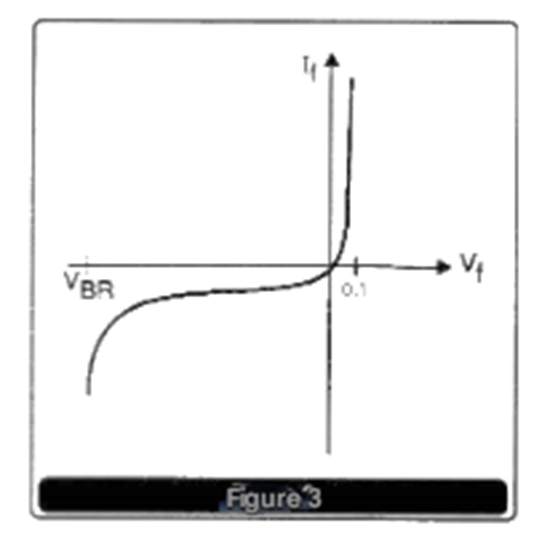
First of all, Schottky diodes begin to conduct at an extremely low voltage, much lower than that of common silicon diodes used in rectification. In addition, the leakage current that flows through a Schottky diode when reverse biased is lower than that found in silicon diodes, see Figure 3.
The switching time, on the other hand, is extremely low, approximately less than 100 picoseconds, which allows its use in very high frequency circuits. For the reverse recovery time, these diodes also have excellent characteristics. In addition to the times being very short, the recovery is smooth, which guarantees a very small reverse "overshoot" when they switch from the fully conducting to the non-conducting state.
In practice, this has some important benefits such as eliminating the need to use "snubbers" in circuits to prevent the appearance of high voltages in the switching devices due to the switching speed.
IN PRACTICE
The first problem encountered by the designer who intends to use Schottky diodes is that common types rarely have reverse voltages that exceed 100 V (Vrrm).
The issue is that when Schottky diodes are manufactured with higher reverse voltages, the forward voltage required for conduction also increases, and their conduction properties then approach those of common diodes, therefore there is no advantage in using them.
The properties of Schottky diodes are determined by the height of the energy barrier of the material deposited on the silicon during the manufacturing process. A metal with a lower energy barrier minimizes the forward voltage, but also restricts the ability to operate at high temperatures. In addition, higher leakage currents occur. On the other hand, a higher barrier minimizes temperature and leakage, but increases the forward voltage required for conduction.
Thus, depending on the application, manufacturers must play with these characteristics in order to obtain a diode that has the desired characteristics.
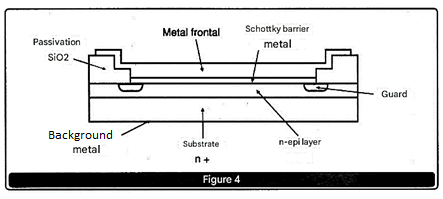
Figure 4 shows an example of a structure adopted for the manufacture of a Schottky Diode by Microsemi. In this structure, we have a ring that surrounds the pn region, which acts as a suppressor for the absorption of reverse energy. In any case, we can find a wide variety of circuits, mainly those requiring high-efficiency, low-loss rectification at high frequencies that make use of Schottky diodes.