ART5407S ART5553
Michael A. Shustov (Shustov is our collaborator directly from Russia.)
Note from Newton C. Braga:
Many complain that Brazilian scientists do not receive due recognition outside Brazil. In fact, perhaps this occurs in a way that we perceive in our own way, but it is not always true. Thus, in the case of Landell de Moura, who many say is "forgotten," his recognition outside Brazil occurs in a way that we highlight in this article. He reflects the views of a Russian author who gives him due recognition, for which we are grateful, rightly praising his work in the discovery of radio along with others such as Marconi, Popov, etc.
In 1892, the first wireless message transmitter was created in Brazil by the Catholic priest Father Roberto Landell de Moura, apparently using optical communications [1–6].
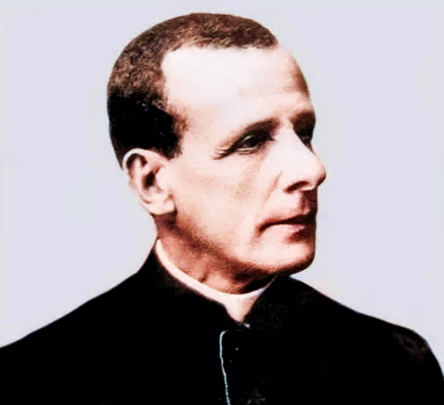
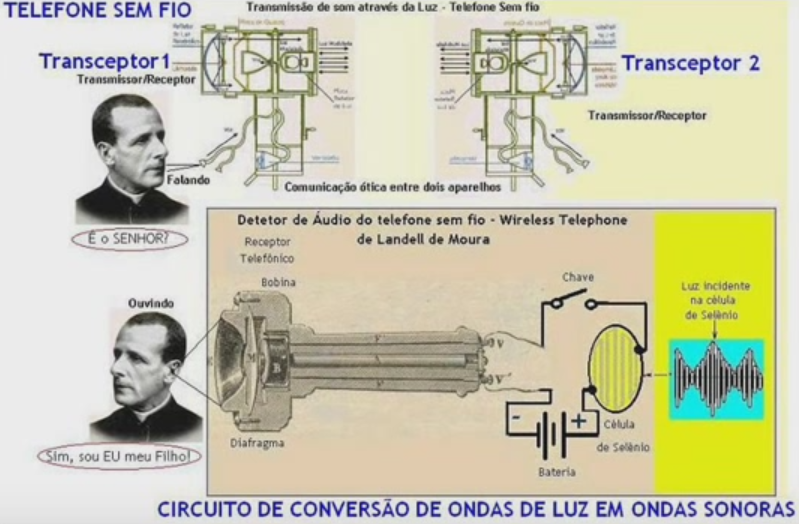
In 1894, Roberto Landel de Moura demonstrated the transmission of voice and music using optical communication over distances of up to 8 km. The receiver and transmitter were based on searchlights using parabolic reflectors and lenses. The transmitter consisted of a power source, an arc light source with a light-control membrane. The receiver contained a light-sensitive selenium plate, a battery, and a telephone.
Because Roberto Landel de Moura was a priest, the Catholic Church accused him of making a deal with the devil, and the inventor's laboratory and equipment were destroyed. To continue his work, Roberto Landel de Moura was forced to emigrate to the United States, where he was able to patent his inventions. [4]
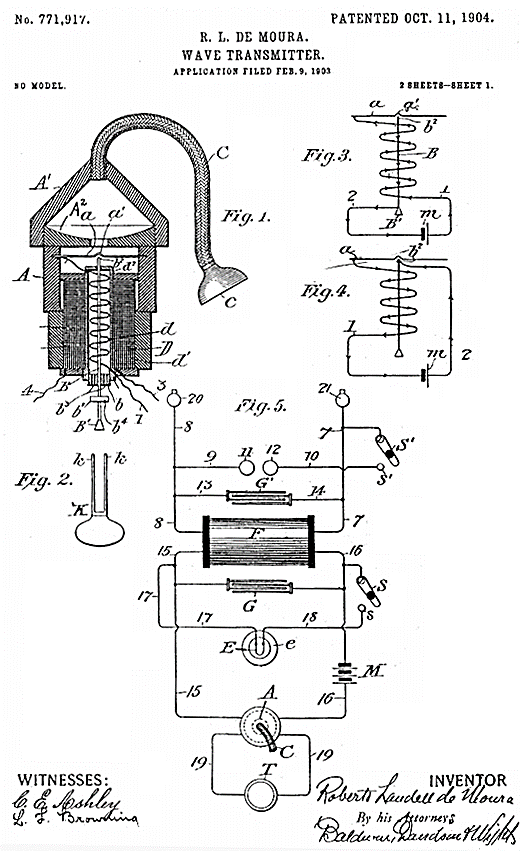
On March 9, 1901, Brazilian patent No. 3279 was granted to Roberto Landel de Moura for an optical communication system, entitled "Phonetic transmission at a distance, by wire and wireless, through space, the earth, and the aqueous element." The patent describes two variants of the device: the "Tellogostomo" and its simplified version, the "Telauxophone."
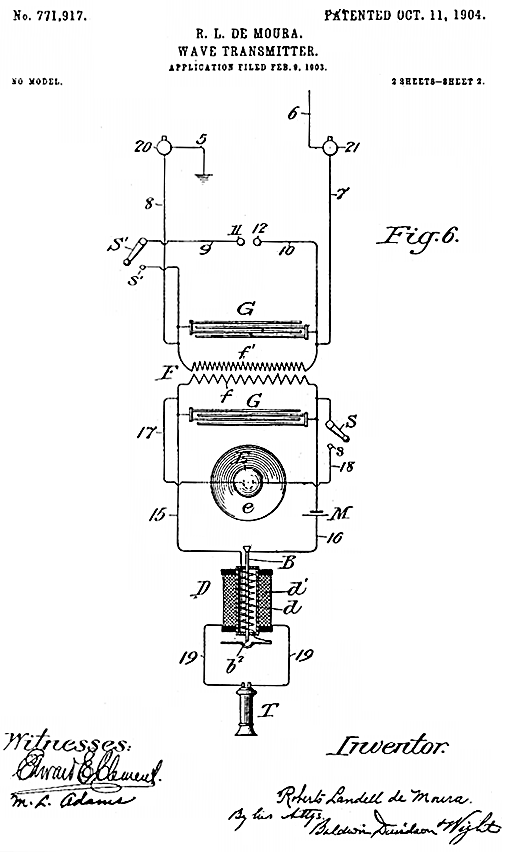
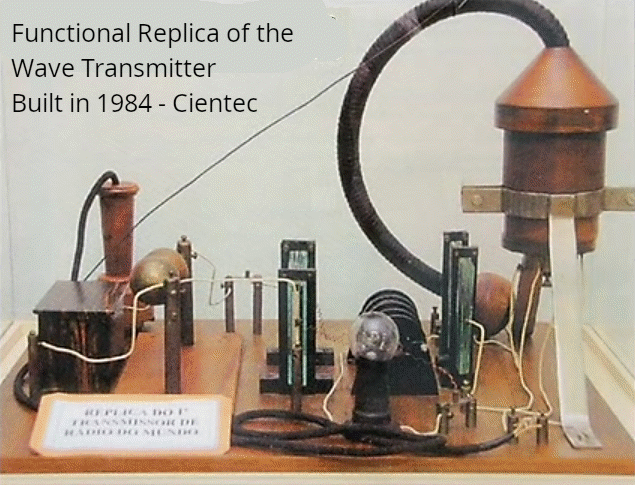
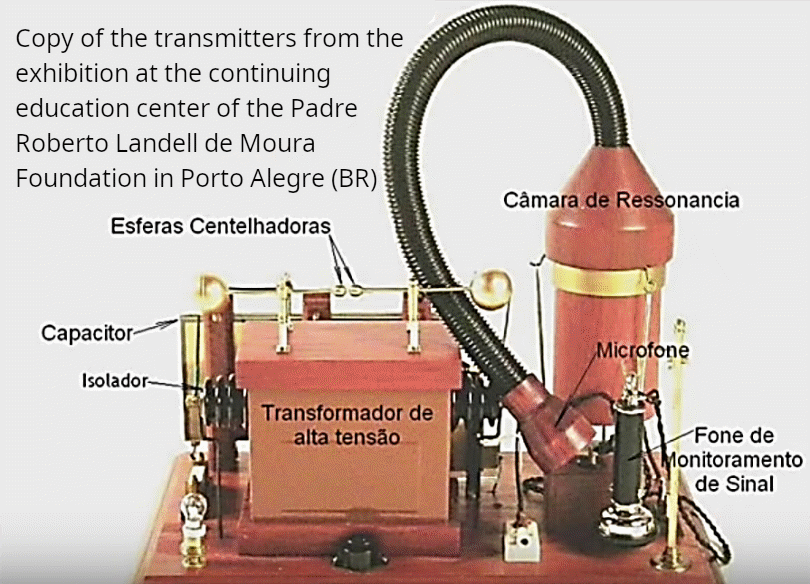
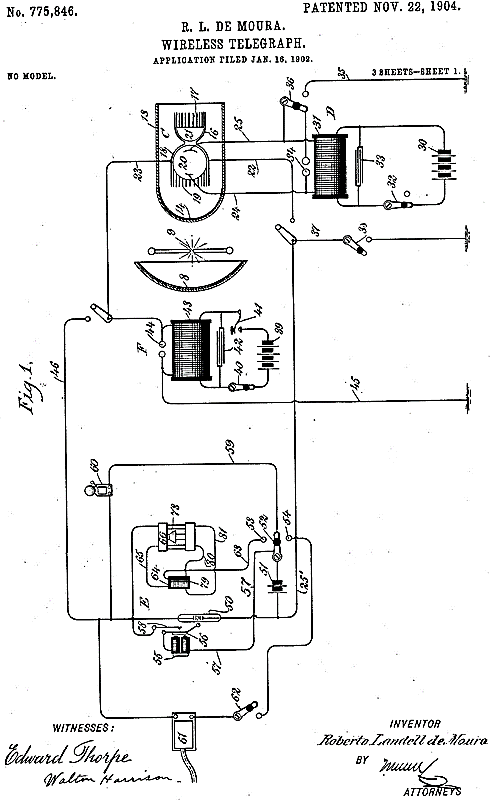
On October 11, 1903, U.S. patent No. 771,917, "Wave transmitter," to Roberto Landel de Moura, was granted priority status on February 9, 1903. The second patent, No. 775,846-dated November 22, 1904, "Wireless telegraph," was registered on January 16, 1902.
The third patent, No. 775337-dated November 22, 1904, "Wireless telephone," was registered on October 4, 1901. Roberto Landel de Moura's patented means of transmitting and receiving information utilized advanced optical and wireless radio technologies.
The device's transmitter had a telescope for aiming the receiver, as well as a compass for orienting the area and locating the receiving device. The transmitter's electric arc lamp was powered by a voltage-increasing transformer (Ruhmkorff induction coil), whose primary winding was driven by a battery through a current circuit breaker.
A parabolic mirror made of polished sheet metal or glass reflected and formed a directed beam of shortwave optical radiation (ultraviolet and blue-violet light). The luminous flux was modulated by acoustic vibrations (speech or music). To increase the noise immunity of communications, polarized light, obtained through a special grid, was apparently used.
The receiver also contained a system of mirrors and lenses, whose light was focused on a photosensitive selenium plate. The amplitude-modulated light flux was converted into an electrical signal, perceived by the ear through a telephone capsule. In addition to the optical communication channel, the devices contained a switchable electromagnetic wave receiver: an antenna, a cohere, and a relay to periodically agitate the cohere. The transmitter part contained a controlled spark source of electromagnetic waves.
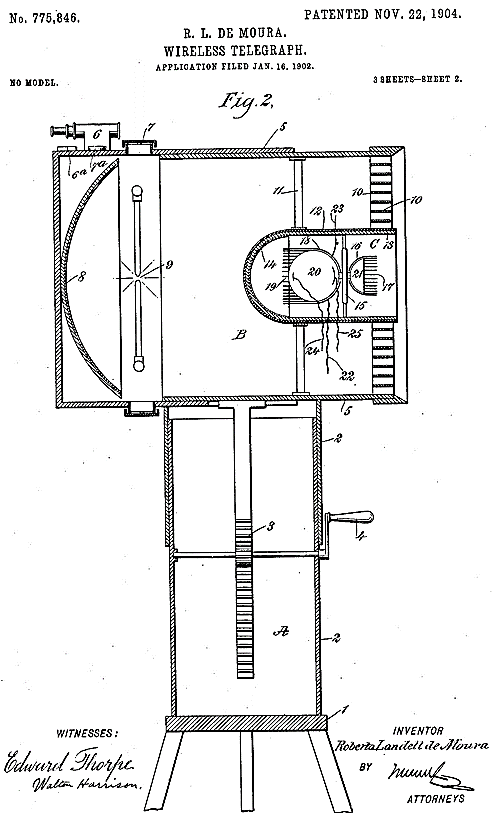
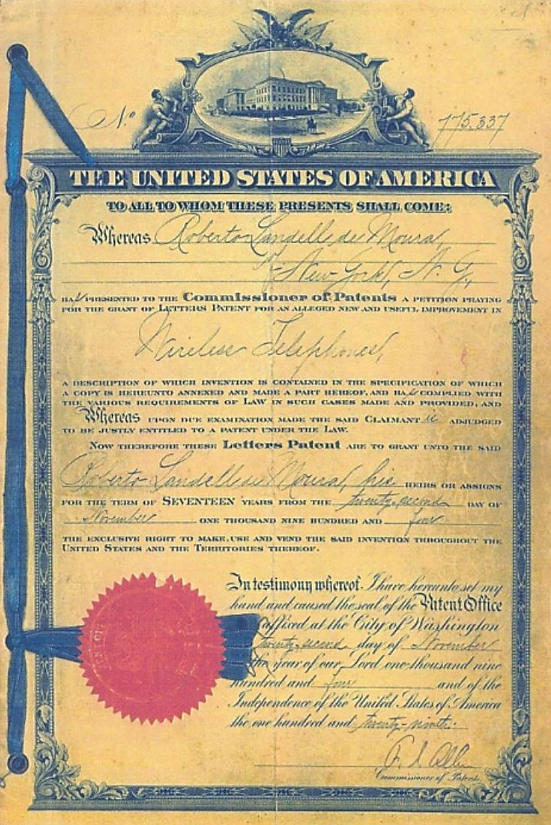
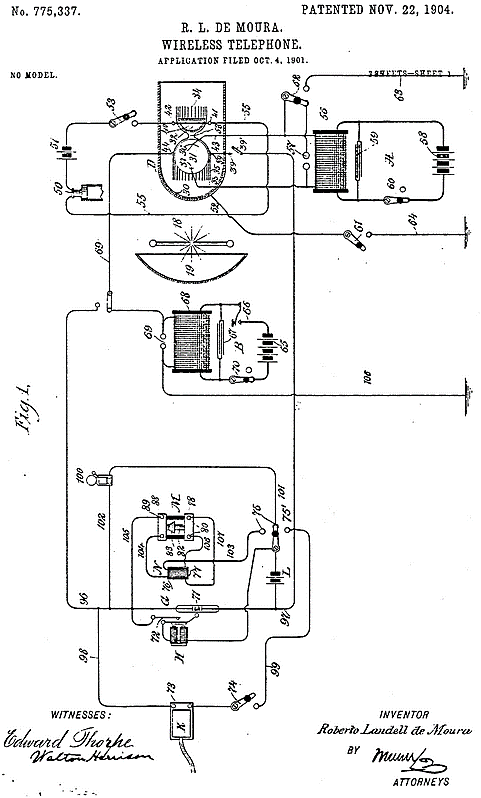
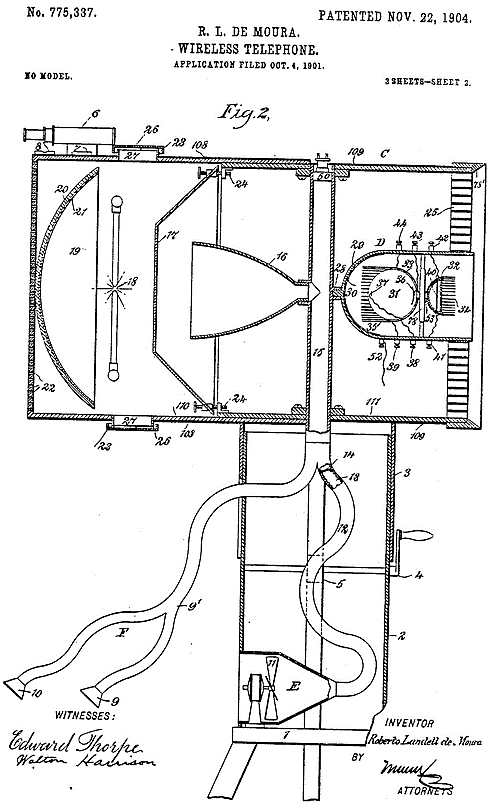
On October 12, 1902, the New York Herald, Fifth Section (USA), published an article about Roberto Landell de Moura's inventions entitled "Talking over a gap of miles along a ray of light" [5].
On August 20, 1904, Roberto Landell de Moura proposed an original method for transmitting images over distances, "The Telephotorama" or "Remote Viewing" [5], but failed to implement it in practice.
In 1904, Roberto Landel de Moura created the first electro photographic camera, called the Electro photographic Machine [6–8]. Between 1904 and 1912, he received hundreds of photographs of electrical discharges of the glow of the human body and gave the glow itself the romantic name "Perianth," meaning the outer part of the flower, its surrounding leaves, petals, stamens, and pistil.
A few decades later, in Brazil, Landel de Moura's work on electric discharge photography (bioelectrography) was continued by Prof. Newton Oliveira Milhomens (1937–2007), Prof. Rodrigo Campos, Prof. Newton C. Braga, Dr. Max Berezovsky, Dr. Auri Silveira Silva, Dr. Joston Miguel Silva, Dr. Hernani Guimaraes Andrade, Dr. Manoel A. Sperb Bacellar, Dr. Paulo de Castro Teixeira, Dr. Célia Cruz, Dr. Hélio Grott Filho, Dr. Júlio Grott, and many other researchers.
In 2000, the bust of Roberto Landel de Moura was exhibited at the Kirlian Museum in Russia, alongside the busts of the Kirlians, along with a book that tells the biography in Portuguese of this eminent Brazilian scientist [8].
BIBLIOGRAPHY
[1] Hamilton Almeida. Father Landell de Moura. A Hero without Glory. Editora Record, 2006. 319 p.
[2] de Assis, Altair & Santiago, Arnaldo & JR, C.E. & Azevedo, Chaleilson. A History of Technological Innovation in the Light Spectrum. 2013. 148 p.
[3] Alencar M. S., Alencar T. T., Lopes W. T. A. What Father Landell de Moura Used to Do in His Spare Time. http://www.memoriallandelldemoura.com.br/imagen/documentos/landell_de_moura.pdf
[4] Priest Roberto Landell De Moura (The Brazilian Radio Amateur Patron) January 21, 1861 – June 30, 1928. http://www.landelldemoura.com.br/lm04.htm
[5] Ivan Dorneles Rodrigues (PY3IDR). History of Telecommunications - Chronology. https://cluberadioamadorcmpa.blogspot.com/
[6] Shustov M.A. History of Electricity. Moscow; Berlin: Direkt-Media. 2019. 567 p.
[7] Korotkov K.G., Shustov M.A. The Kirlian Effect - Past and Present. Saint Petersburg-Tomsk, 2017. 144 p.
[8] Korotkov K.G. The History of Bioelectrography.
https://www.iumab.org/history-of-bioelectrography/


